Fish-men
The Blazing WorldThe Fish-men are a numerous aquatic people of the Blazing-World whose roles extend from natural inquiry to imperial service. Also called Mear-men or Syrens, they observe marine life and the sea, locate a passage between worlds, move the Empress’s ships underwater, and carry out the naval strategy that destroys hostile fleets and establishes tribute for the King of Esfi. They are not merely instruments of power: the account also gives them a professional discipline, a place in public entertainment, and a distinctive collective voice.
Identity and Work
The Fish-men belong to the many species of the Blazing-World, whose inhabitants pursue occupations considered suited to their respective kinds. The Empress assigns them, together with the Fly-men and Worm-men, the study of natural philosophy. Their role is institutional as well as individual: the Empress encourages specialized arts and sciences, establishes schools, and founds learned societies for their work.
Their investigations include the composition and motion of the sea. Asked why the sea is salty and why it ebbs and flows, they propose that volatile salt in the earth surrounding the waters is absorbed by the sea and becomes fixed. In their account, this absorption causes the tides; portions of salt that are less readily absorbed rise and bear up the water. They offer this explanation in place of theories that attribute the sea’s motion to the Earth’s movement or the Moon’s influence. The episode presents a specific natural-philosophical claim, not a narrator-certified account of how the sea works.
The Fish-men also examine animal life in water. They report that some aquatic creatures have blood and others do not: Crea-fishes and lobsters have little, while crabs, oysters, and cockles have none. In lobsters, they locate a small vein through the middle of the tail; in Crea-fishes, they find it in the back. They describe other fish as having blood near the gills or in other limited areas, but say they have not observed veins spread throughout a body. Their observations lead the Empress to ask how animals without blood can live. The Fish-men and Worm-men answer that blood is not essential to animal life, explaining what are commonly called animal spirits as bodily motions appropriate to an animal’s nature and shape.
Their account also marks a boundary to observation. Asked whether blood circulates in veins and arteries, they say they cannot provide an exact report: circulation is an internal motion that their senses and optical instruments cannot detect. Dissection cannot settle the question, because opening an animal alters the internal motions proper to its figure. Their investigations therefore yield detailed observations while acknowledging that the act of inspection can change the object under study.
Exploration and the Passage Between Worlds
When the Empress seeks a route from the Blazing-World to her native country, the Duchess proposes that the Fish-men search for one. A large number are sent to explore in different directions. They find a single passage, but report that it is so narrow that no vessel larger than a packet-boat can pass through, and that it sometimes freezes entirely. Their discovery enables the expedition while also exposing a serious constraint: the connection between worlds is neither broad nor reliably open.
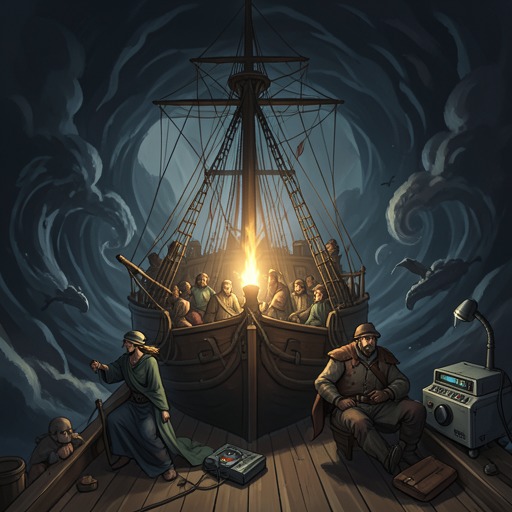
The Fish-men’s maritime abilities help the expedition adapt. During the crossing, they draw the golden ships underwater with golden chains through the short passage between the worlds. Sails are unnecessary there; the ships instead have to keep water out and provide enough air for the land animals aboard. The Giants have designed them to meet those requirements. After the ships pass through the Icy Sea, they surface and continue toward the Empress’s native country.
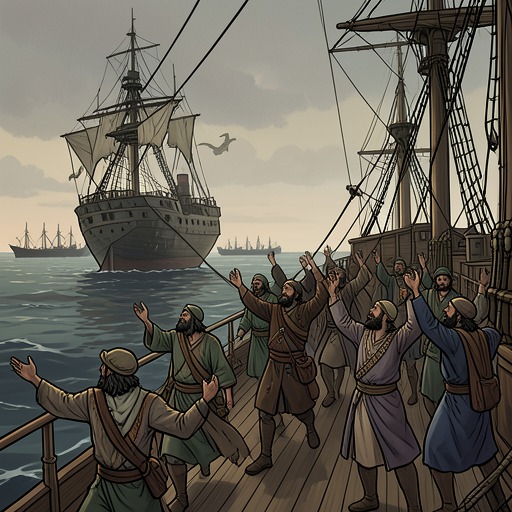
The Fish-men’s logistical role grows with the scale of the undertaking. The Empress commands many of them to accompany her beneath the water, while Bird-men travel in the air and Bear-men and Worm-men travel aboard ships. The ships are not built for cannon warfare, and their gold plating cannot prevent an enemy from boarding them and taking them as prizes. The Duchess therefore argues that large numbers of Fish-men must serve in place of cannons by destroying enemy ships before they can approach. The expedition’s provisions and vessels must also accommodate the many subjects who wish to accompany the Empress, including Bird-men who need to rest during long journeys and at night.
Naval Campaign and Imperial Consequences
The Duchess’s plan assigns distinct tasks to the Fish-men and Worm-men. Worm-men are sent to the Burning-Mountains to collect Fire-stone, which burns while wet; Fish-men are to use it against wooden ships. In the night attack, Fish-men carry the Fire-stones, cut into torch-like forms, out of the water and hold them aloft, helping create the appearance that both air and sea are ablaze. This display makes spectators near the sea believe the Last Day has come, and they fall down to pray.
The following morning, the Empress gives the Fish-men more exact orders. They carry Fire-stones in diamond cases and are to uncover and wet them only when directly beneath or beside enemy ships. Once ignited, the fires reach the ships’ gunpowder, causing the fleet to explode. The account credits the Fish-men’s execution of this tactic with the rapid destruction of the invading navies. The spectacle initially leads the Empress’s countrymen to regard her as an angel sent to deliver them; military victory thus becomes both a practical rescue and the basis of an extraordinary public reputation.
The campaign then shifts from defending the King of Esfi’s country to enforcing his authority overseas. At the Empress’s command, the Fish-men destroy foreign ships engaged in maritime trade when neighboring nations refuse to pay tribute to the King. The nations eventually submit after prolonged negotiations, and the King becomes master of the seas; the narrative links this maritime control to the dependence of many countries on trade and commerce by water. When neighboring powers later unite against him, the Fish-men again destroy the remainder of their naval forces. Some nations resist because they can live without foreign trade or rely entirely on land commerce, leading the Empress to threaten their towns and cities with Fire-stone. The Fish-men’s victories therefore secure the tribute system by sea, but they also extend the threat of conquest beyond maritime combat.
Public Life and Narrative Significance
The Fish-men’s service is not confined to exploration and war. During the Empress’s entertainment for foreign princes, they provide music from the sea, answered by the Bird-men singing in the air. The exchange makes sea and sky seem to converse in song. In ordinary recreation, their music accompanies entertainments on the water; the account also describes dancing on the backs of Fish-men lying closely together, though it does not establish whether those participants are specifically the same Fish-men serving the Empress’s fleet.
These varied appearances place the Fish-men between knowledge, labor, art, and force. Their observations are valuable but not omniscient; their expertise cannot reveal an internal motion that vanishes from view when an animal is dissected. Yet the expedition depends on their capacity to search, tow ships through a frozen and narrow passage, and carry out a coordinated attack underwater. The same people who investigate the movement of the sea also move imperial power across it. Their role gives the Blazing-World’s specialized society a concrete political consequence: natural and technical capacities, organized under the Empress’s command, become the means by which the King of Esfi’s maritime dominion is established and maintained.